Filed Under:
A burgeoning AI boycott plasters the NYC subway
New Yorkers began vandalizing ads for dystopian AI products bombarding the city last fall, sparking a larger movement of AI rejection

Joseph Mogul
Real journalists wrote and edited this (not AI). Independent, community-driven journalism survives because you back it. Donate to sustain Prism’s mission and the humans behind it.
On a brisk November night, two anti-AI artists descend into the 125th Street subway station in Harlem, New York, and board the first train to arrive, a downtown 2 train. Rather than scan for available seats, their eyes are focused on the advertisements above. They spot an ad for an investment product called Moomoo: “Using AI that’s built for traders,” its tagline reads.
Bingo.
The two artists make eye contact and one of them reaches into a brown bag for a footlong sticker that reads, “AI is not inevitable.” They inconspicuously plaster it over the Moomoo ad.
For the next half hour, Lake and Lynn—who, like all the sources for this story, are using pseudonyms for fear of legal repercussions—bounce from one subway car to another, tagging ads that are AI-generated or promoting AI products. Some cars they enter are sparsely populated; others are jam-packed and their action arouses attention. The pair draws some curious looks while stickering an ad for a company called Clay, which sells “enriched” data to AI conglomerates such as OpenAI and Google. Passengers look up from their phones to take note of what’s happening around them. One onlooker nudges their friend and gestures toward the newly stickered Clay ad that now reads “boycottAI.noblogs.org.”
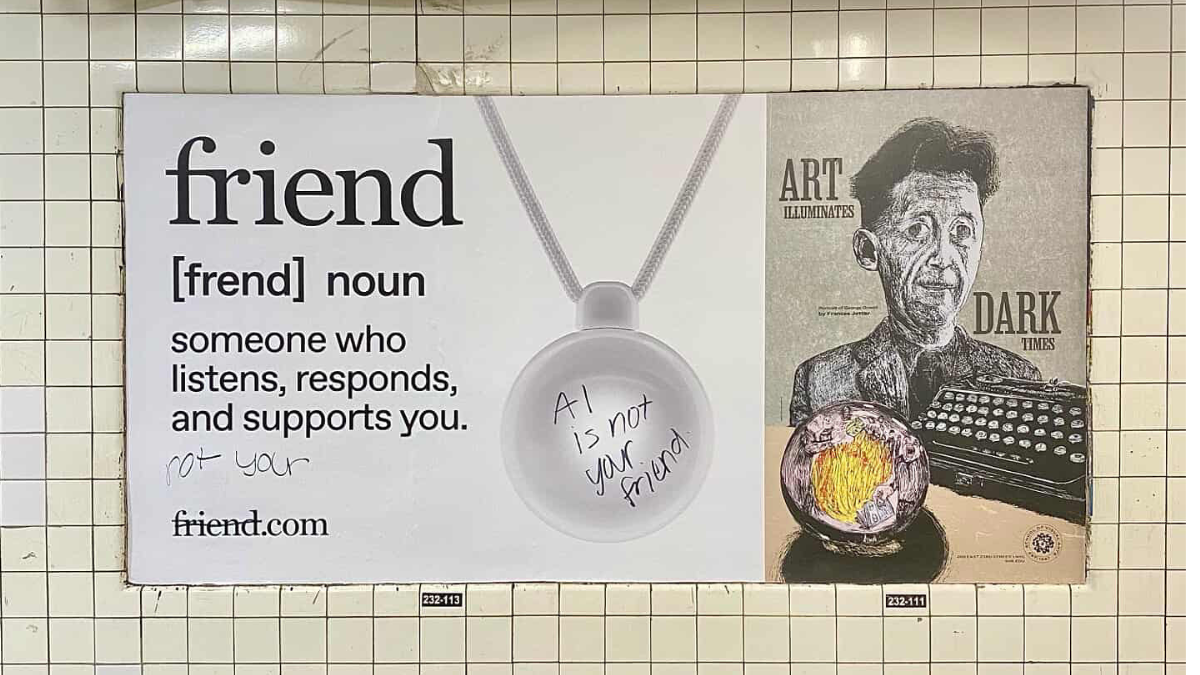
Boycott AI and other similar autonomous art projects began last September amid one of the most expensive and expansive subway marketing campaigns in New York City history. Across the five boroughs, the subway system was littered with more than 12,000 advertisements—totaling $1 million—for a company called Friend, which sells a $129 wearable AI companion. Friend pendants are equipped with a camera and microphone; they can listen to users’ conversations, monitor their surroundings, and communicate via the Friend app using Google Gemini’s AI chatbot.
Critics have derided Friend as a thinly veiled anti-human surveillance company, but Friend’s braggadocious and widely quoted CEO, Avi Schiffmann, told The New York Times that his company’s goal is to “redefine what a friend is.” (He also described launching his ad campaign while attending the Burning Man music festival as “life-maxxing.”) The not-so-subliminal message from the ubiquitous advertisements is that people should ditch their imperfect human friends for a more frictionless AI friend. “I’ll never bail on our dinner plans,” reads one ad.
My first reaction was: This should be illegal, the way you can’t have a massive subway ad for cigarettes.
“Sarah,” co-founder of stopfriend.com
The epicenter of Friend’s marketing campaign, which largely spanned from September through November (though a few ads remain) was the West 4th station in Manhattan’s West Village. Sarah, a technology researcher studying the political impacts of AI, passes through the station every day. “You have to walk quite a bit from the train to get outside, and there’s a 15 second period where you’re in a tunnel of friend.com ads,” she said. “My first reaction was: This should be illegal, the way you can’t have a massive subway ad for cigarettes. … I was really hoping someone would sabotage it.”
Over the next two months, New Yorkers wielding permanent markers, stickers, and spraypaint—including those who founded Boycott AI and stopfriend.com—would do just that.
While Friend ads were the initial canvas for mass art action, this marketing was evocative of a pervasive narrative beamed across a range of subway advertisements and broadcast around the world: that AI is inevitable. “Friend is really saying the quiet part out loud: We’re trying to replace human relationships with AI,” said Magdala, a digital artist who worked on stopfriend.com with Sarah. “It’s very good as a symbol of what could go wrong.”
As tech giants force-feed AI inevitability marketing and trumpet the technology’s supposed benefits to society, a robust AI-resistance movement has emerged in response. Organizers across the U.S. are slowing down and halting AI data centers; tech workers are demanding that their employers stop supporting militarism; communities are pressuring cities to end contracts with AI surveillance companies; and artists are suing generative AI platforms over copyright infringement. The backlash against Friend was not just a rejection of one company, but emblematic of a larger struggle.
AI resistance
One day during Sarah’s walk down the West 4th station Friend tunnel, she had an idea. “I was coming out of the station, and … I thought it would be really funny if someone were to buy the domain name ‘stopfriend.com,’ so I bought it instantly, sat down for an hour, and put up a webpage.”
Sarah—who was politicized in her hometown of Cairo, during the Arab Spring—is a self-described “internet nerd” and “really likes hoarding domain names for random side projects.” She wasn’t sure what the function of the website would be yet, though anti-Friend graffiti had recently started to proliferate, and she wasn’t the only person to take notice.
Magdala, who Sarah followed on Instagram but hadn’t met in person, shared a post saying that they were documenting anti-Friend graffiti. Sarah messaged Madgala, offering use of stopfriend.com. Magdala was enthusiastic about the collaboration, and they got to work building the website, adding AI literacy and local mutual aid resources alongside an archive of Friend vandalism. They also designed and printed QR code stickers linking to their website, which the pair distributed to friends who placed them next to anti-Friend graffiti.
Sarah and Magdala documented a wide array of anti-Friend graffiti, including: “enemy.com” written over “friend.com,” “make a real friend,” “look up Palantir,” and “this is a surveillance tool, free Palestine, abolish ICE.” Some of the ads were torn down altogether. Another prominent slogan was “join the Luddite Renaissance,” an homage to the 19th century movement of English textile workers who destroyed automation machines deployed by factory owners to displace their labor, depress their wages, and immiserate their lives—and a title that AI opponents are reclaiming.
While Prism couldn’t confirm it, Sarah believes the first people to tag Friend ads were informal groups of high schoolers calling themselves Luddites. “The first wave was very coordinated. There was a day where six or seven graffiti locations showed up,” said Sarah.
After that first wave, the floodgates for autonomous action opened.
An emerging boycott
Lake and Lynn—who also embrace the Luddite title—met in September at the NYC Anarchist Book Fair, where the conversation quickly turned to AI. “We are both working in our daily lives in different professions in which AI is a very pressing issue,” said Lake, an “AI vegan” and adjunct professor who taught their first semester in the AI era last fall. As many educators struggle with how to navigate AI in the classroom, Lake was upfront with their students about their firm anti-AI position, which they believe led to vastly fewer ChatGPT essays than their AI-agnostic educator counterparts.
Lynn, a computer science Ph.D. student at Columbia University, works in the AI fairness industry. “The field I’m in is trying to make AI responsible. … The prototypical example is to make your recidivism predictor not racist,” she said, referencing a 2016 ProPublica investigation about how courts used an algorithm rife with anti-Black racism to make sentencing decisions. While Lynn’s day job is minimizing algorithmic racism, her personal politics are abolitionist, and she believes resisting AI is “explicitly related [to prison abolition] because surveillance technologies are a huge part of what’s fueling increasing imprisonment.”
Before launching the Boycott AI project, Lynn and Lake were each searching for an outlet to channel the rage they felt about the widespread embrace of AI. “One of the first conversations we ever had was about how collective resistance to AI just needed to start yesterday,” said Lake. They found a perfect target for that resistance in the Friend ad campaign. “Friend is not going to become the next Amazon,” they said, “but we were in a particular moment where Friend was omnipresent.”
They printed out stickers and started hitting the subways together, distributing roughly 100 stickers in a few weeks. “We were nervous the first time, but cool and collected since then,” Lake explained.
While Friend ads were a “big obvious target,” according to Lynn, their subway actions were never tightly restricted. From the outset, any ad that fit their criteria of being either AI-generated or promoting an AI product warranted a sticker. They even printed stickers specific to certain companies, such as Monday.com, an AI work management company that uses an AI-generated llama to market their products. “Don’t trust this AI llama with your data,” the sticker read. Some AI ads were even vandalized multiple times by separate parties, documenting a layered tapestry of autonomous action.
The Boycott AI project is grounded in the principle that personal consumption choices can catapult into a collective boycott movement—and this is crucial to resisting AI, because of what Lynn described as a “tight feedback loop” in data collection. When people use OpenAI’s ChatGPT or Friend’s pendants built on Google Gemini, they offer these companies data to train future iterations of AI technology. Tech giants reliant on streams of user-generated data could be stunted by a collective boycott, rendering their trillion-dollar investments in generative AI infrastructure obsolete. “The way we behave now shapes what AI technology will exist tomorrow,” said Lynn.
By leveraging the virality of Friend ads, Boycott AI hoped to spark broader discourse about AI and popularize the idea of a comprehensive AI boycott. Some AI products marketed on the subway—like Monday.com’s llama—may seem benign, but Lake doesn’t think we can separate these technologies from the more nefarious surveillance and military AI applications. “The way in which these technologies are so enmeshed in this capitalist system we live in, there’s no siloing it,” they said.
Raising consciousness
A mass shift in consciousness is a necessary precursor to an effective boycott movement, according to those behind NYC’s anti-AI campaign.
“Our goal is to popularize more critical and informed perspectives around AI and move the conversation away from ‘is it good or bad’ to just making fun of it,” said Sarah. Lake believes that witnessing somebody vandalizing an ad can have a subtle but significant effect on people. “The difference between seeing an ad that is just posted versus something that has been fucked with in some way, in any way, it’s a documentation of dissent, documenting a way out and an alternative.” On multiple occasions, Lake said, onlookers asked for stickers to put up themselves.
The difference between seeing an ad that is just posted versus something that has been fucked with in some way, in any way, it’s a documentation of dissent.
“lake,” Boycott AI
The subway is a strategic venue for art action. Sarah told Prism that vandalizing AI ads chips away at the large amounts of money companies spend on normalizing AI through advertising.
There’s also a class dynamic with public transit ridership, which primarily serves working-class commuters. While conversations about AI are raging in academia, media, and other insular fields, Sarah said projects like stopfriend.com can go a long way in reaching people outside of those spaces, especially when using graffiti as the medium for their messaging. Additionally, tagging subway ads—an element of the built environment—has symbolic resonance, which Lake described as “directly contrary to what AI is doing, which is eroding our material world and replacing it with a pixelated future.”
As the vandalism proliferated, Sarah believes that it made an impact on AI discourse. “Maybe I’m being optimistic but … it made me feel like pushback is possible, and it’s happening,” she said. One New Yorker even went viral on TikTok after dressing as a vandalized Friend ad for Halloween.
While the Friend ad campaign in New York City has mostly wound down, there were reports earlier this month that Friend ads were also vandalized in the Paris subway. Now, stopfriend has set their sights on future actions. Magdala and Sarah plan to update the stopfriend.com website to be a more robust AI resource hub, in addition to targeting new AI subway ads.
Ultimately, the anti-AI movement is still relatively new and Magdala said organizers are figuring out the best ways to resist in real time. This burgeoning movement will not only include a clear articulation of the dangers AI poses, but also “provide a vision for an alternative future,” said Lynn. She hopes that targeting subway ads increases the appetite for participation in future anti-AI movements and builds the will for further resistance.
“To build a world outside capitalist systems requires so much experimentation, so much deep imagination,” Lake said. “I think autonomous art has such a role to play in that.”
Editorial Team:
Tina Vasquez, Lead Editor
Lara Witt, Top Editor
Rashmee Kumar, Copy Editor
Joseph Mogul
Filed Under: